Thursday, September 19, 2013

An App for Coasting, Rather than Surfing, the Web

Browser builder Opera smartly simplifies the Web on the iPad with touchable tiles.

While computers have changed drastically over the past 20 years, morphing from big boxes to svelte laptops, touch-screen tablets, and smartphones, the Web browsers we use on them have looked largely the same.

Sure, you can take a desktop Web browser, optimize it for a smaller screen, and add some touch features—as the most commonly used mobile browsers do. But the results are often inelegant, because the things you do online on a laptop or desktop computer tend to be different from the things you do on a tablet or a smartphone. And chances are you’re not using a traditional keyboard and mouse, the tools that desktop browser makers could count on you to have.

Apple's New iOS 7: Drastic Changes I think I like

The new version of Apple’s mobile operating system is a lot to get used to, but I have a feeling the changes in iOS 7 are for the best 


On Wednesday, Apple released the latest version of its iOS mobile operating system. First unveiled in June, iOS 7 represents the biggest visual refresh of the software thus far. It’s a change prompted by the company’s design head, Jony Ive, and perhaps also Apple’s competitors (see “Apple’s Mobile OS is All About Ive”).

The software is available as a free download for anyone with a recent model iPhone, iPad, or iPod Touch. Apple’s servers were swamped today, but after a number of failed attempts at downloading it onto my iPhone I was able to get it up and running this afternoon. What follows are some early thoughts after spending some time with iOS 7, in the order at which they occured to me.

Google to Try to Solve Death, LOL

A new company launched by Google will seek to extend human life spans. 


A joke about Silicon Valley is that entrepreneurs always seem to focus on the problems facing people of their own age. That’s why young programmers have endless ideas for Websites that will tell them what bar to hang out in. Then, in middle age and with marriage, it’s onto inventing fertility apps (see “Three Questions for Max Levchin About His New Startup”).

Eventually, as your hair goes grey, you have to fix death itself.
Today, Time magazine broke the news that Google and its CEO Larry Page are funding a company that will try to extend human lifespan and solve the diseases of aging.  The weekly’s next newsstand cover asks, in huge letters, “Can Google Solve Death?”

How Twitter Can Cash In with New Technology

Twitter seeks to do better at inferring its users’ consumer and political preferences, gender, age, and more.

Twitter began selling promoted tweets in 2010, but it has always faced challenges in knowing which of those ads should be delivered to which Twitter accounts. Most Twitter users don’t give up their locations, and many don’t reveal their identities in their profiles. And mining tweets themselves for insights is hard because the language is not only short but filled with slang and abbreviations.

Now, as Twitter plans to sell shares to the public, its success will depend in part on how much better it can get at deciphering tweets. Solving that technological puzzle would help Twitter get better at selling the right promoted messages at the right times, and it could possibly lead to new revenue-producing services.

Wednesday, September 18, 2013

Internet Archaeologists Reconstruct Lost Web Pages

Computer scientists have developed a technique for reconstructing missing web resources from the context in which they appeared, just like archaeologists in the physical world 


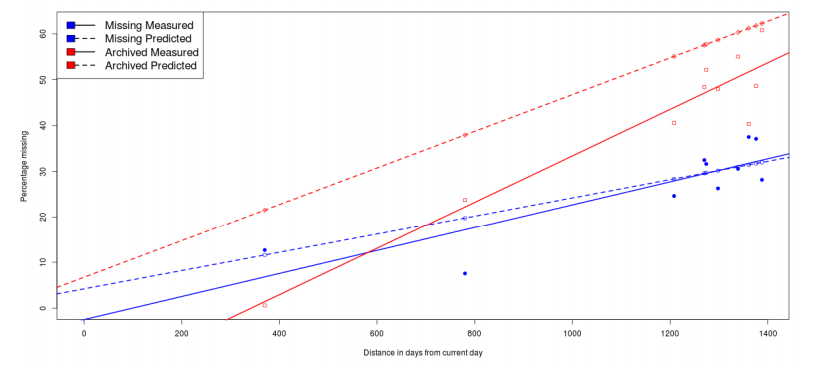
The internet is disappearing. And with it goes an important part of our recorded history. That was the conclusion of a study this blog looked at last year, which measured the rate at which links shared over social media platforms such as Twitter, were disappearing.

The conclusion was that this data is being lost at the rate of 11 per cent within a year and 27 per cent within two years.

Today, the researchers behind this work reveal that all is not lost.  Hany SalahEldeen and Michael Nelson at Old Dominion University in Norfolk, Virginia, have found a way to reconstruct deleted material and say it works reasonably well.

Voice-Analyzing App Scans Football Players for Concussion

Notre Dame researchers will test a concussion-detection app on nearly a thousand high school and youth football players.

A voice-analysis program run on a tablet could help high school and youth coaches recognize concussions on the sidelines of football and other high-impact sport games.

After identifying concussions in collegiate boxers in a preliminary study, University of Notre Dame researchers will soon test the app on approximately 1,000 youth and high school football players. The program pulls out the vowel segment from a set of predetermined words and then analyzes that sound for changes that may indicate a brain injury.

Esther Dyson: We Need to Fix Health Behavior

Getting people to eat well and exercise is the biggest unsolved problem in health care.


Esther Dyson is a former reporter and Wall Street analyst who has set out to tackle what she calls “the most interesting unsolved problems in health care and human behavior.” Top among them is the high rate of self-inflicted illness from bad diet and too little exercise.

In March, Dyson released a manifesto describing new idea: create a challenge among small U.S. cities to see which can most improve its health, measured by factors like weight, blood pressure, and sick days. The effort, she says, will be propelled by hard data on the best prevention practices, and aims to find ways to turn good health into a profit-making strategy.